Between fires and mutinies: what the first crossing of the Strait of Magellan felt like
Imagine sailing out into the Mar del Sur without knowing what was on the other side. That’s what Magallanes and his people did in November 1520.
Would you dare to sail toward a sea no one had ever seen?
Think about this for a second: Wednesday, November 28, 1520. On the deck of a wooden carrack, the wind slices your face, your clothes are stiff with salt, there’s almost no fresh food left, nobody knows for sure where they are. There’s no GPS, no clear charts, not even a name for the dark water opening ahead. And yet they move forward. Antonio Pigafetta, who has been jotting everything down as best he can, writes: “Wednesday, November 28, we emerged from the Strait to enter the great sea, which we at once named the Pacific…”
More than five hundred years later, we can stand on the Patagonian coast and look toward the Strait of Magellan knowing how the story ends: that natural channel links the Atlantic with the Pacific, and this expedition will become the first documented circumnavigation of the world, completed in 1522. But in November 1520 no one had a happy ending guaranteed. That’s why I go back to imagining those days of wind, treacherous currents, and enormous doubts. To really understand what it feels like to be the first one who goes into a passage that might not have a way out.
Southern winds and a cape with a party name
The neat version of the story usually starts in Seville, 1519, with the five ships neatly lined up: Trinidad, San Antonio, Concepción, Victoria, and Santiago. It’s the “Armada for the discovery of the Spicery,” headed by Ferdinand Magellan, a Portuguese navigator in the service of the Spanish Crown. But the chapter that matters to us begins much farther south, when the expedition has been at sea for more than a year and the Atlantic stops being the known sea to become a realm of suspicion.
Around those days in October or early November 1520, sources disagree—some name the 21st, others the 1st—but in any case the ships are advancing toward a coast that looks like nothing they knew. The cold bites, the southern wind hits from the side, and the night watches are a strange mix of routine and fear. There, at the eastern mouth of the strait, Magellan sees a jut of land and decides to name it Cape of the “Eleven Thousand Virgins,” after the feast of Saint Ursula and her companion martyrs.
Pigafetta says that by those days they already had mutinies put down behind them, arguments, and the constant feeling that the crew could break at any moment. Many Spaniards distrusted the Portuguese captain in the service of Castile; to that distrust were added the concrete facts: incomplete maps, rumors that the coast went on south forever, and a harsh winter that had been hitting hard.
Still, on seeing that channel between jagged coasts they decide to go in. In the chronicler’s account they call it the “Patagonian Strait,” not yet of Magellan, because that will come later, when the story is told and filed away. In that instant it’s just a gash of unknown water that could end anywhere at all, even in a landlocked bay where they might be trapped forever.
Crossing the strait: fear, fires, and relief
Inside there begins the part that fascinates me the most. Pigafetta notes that the crossing takes 26 days, with strong winds, capricious currents, and that mix of beauty and danger that the far south still has today. As they advance, they discover something that gives them a bit of relief: “We called that strait the ‘Patagonian Strait’; in which, every half league, there are very safe harbors, the best of waters, firewood – though only cedar – fish, sardines, mussels and celery….” In other words: for the first time in a long while, there is food that doesn’t come out of a rancid barrel.
I like to imagine that contrast. After months of hard biscuit and half-rotten water, suddenly there appears a corner of the world where the sea offers up sardines and mussels, where the coast offers wood and fresh water at every turn. It’s as if the strait, so feared on the maps, were holding out a hand: come through, but don’t get too confident.
Because at the same time, the landscape speaks to them in another language: on the shores of the great southern land, they see numerous fires shining in the night, lit by the peoples who live there. Pigafetta recounts those red dots in the darkness, and Magellan decides that this region will be called “Tierra del Fuego,” Land of Fire. Imagine what it must have been like to see that from the deck: a black line of coast, the cold cutting through you, and suddenly small embers flickering on and off. Each fire is a life, a family, a story they don’t understand.
In that southern world the “Patagonians” of Pigafetta also appear, those inhabitants of the southern region of South America whom many studies associate with Tehuelche or Aonikenk peoples. Modern sources recall that we don’t know precisely which specific groups those accounts refer to, and that centuries of European exaggerations were built on their bodies, heights, and customs. But beyond the myth, the concrete fact is that in that landscape we now recognize as Patagonia, in 1520 mistrustful gazes cross paths. Some have come looking for a passage to the spices. The others are probably seeing strange lights in the water and wondering who these people are who arrive in floating houses.
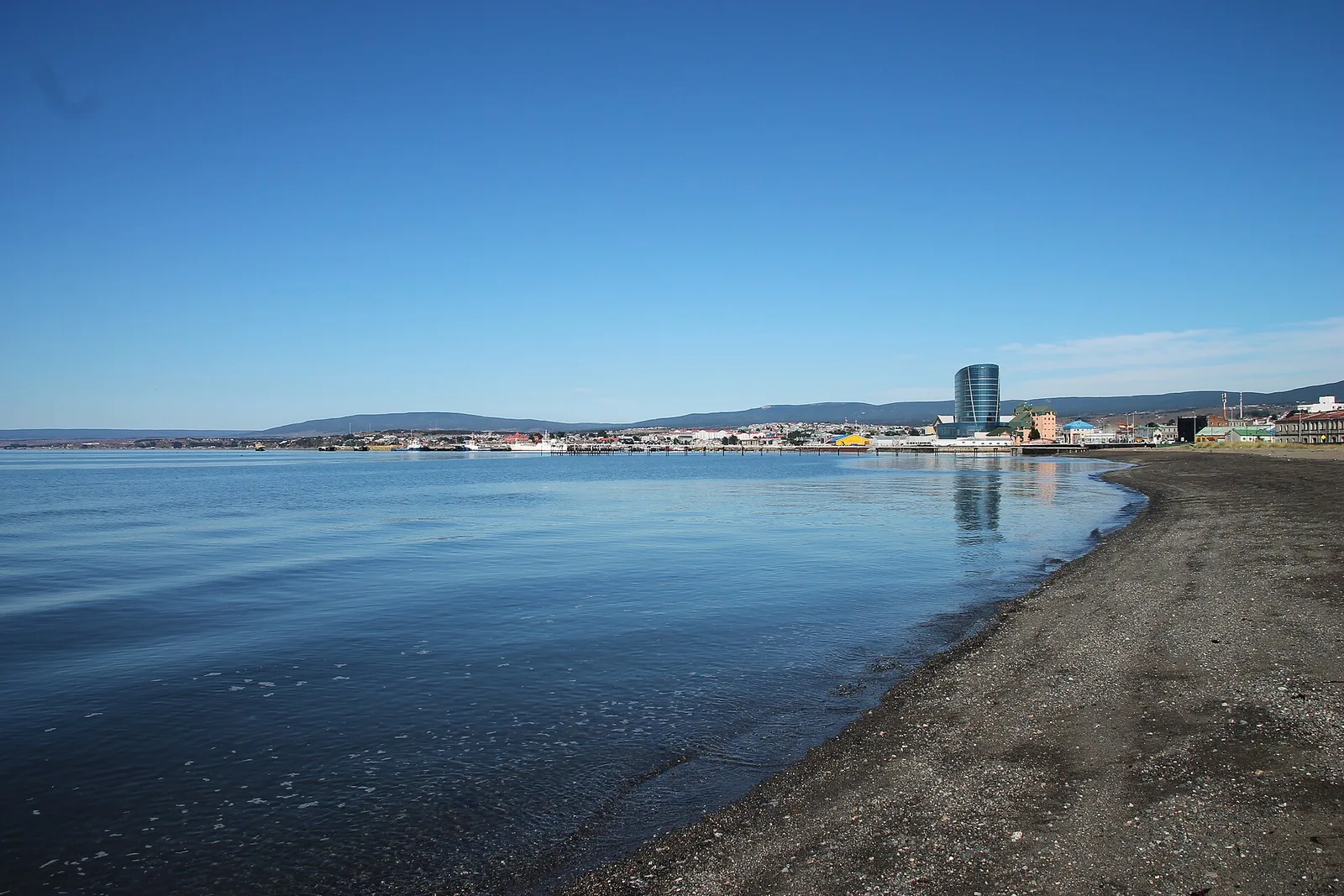
Coast of Punta Arenas next to the Strait of Magellan. Photo: Draceane, CC BY-SA 4.0, via Wikimedia Commons.
Mutinies, accounts, and Magellan’s stubbornness
As the strait zigzags, so does the crew’s mood. Chronicles and later studies speak of prior mutinies, attempts to turn back, disputes between captains. That’s where something comes into play that we sometimes forget when we think of “great explorers”: Magellan wasn’t a bronze hero, he was a stubborn guy, with a dangerous mix of calculation, faith, and hardheadedness. According to the accounts based on Pigafetta, he stands firm in continuing to look for the exit to the “South Sea” despite the fear of many of his men and the precedents of rebellions.
Picture the scene: pitch-dark night, the ship creaks, anchors are made ready in case they need to take refuge at full speed in one of those sheltered bays the chronicler praises so much. Someone quietly says this makes no sense, that it would be better to go back to the usual African route. Another complains about the cold. Some officer does the math on provisions and the numbers don’t add up. In that climate, the difference between advancing and retreating can come down to an order given with confidence at just the right moment.
At the same time, the versions about the dates show something else interesting: even five centuries later, historians argue over whether the formal entry into the strait was on October 21 or November 1, whether the passage to open sea took place on November 27 or 28. A popular science document speaks outright of November 27 or 28, 1520 as the moment when they find the exit to the other ocean. We don’t know it with absolute precision. But we do know that Pigafetta himself writes that on “Wednesday the 28 of November 1520” they emerge into the great sea. I like that image of an ordinary Wednesday that ends up being, without their knowing it, a day that will later be remembered on museum panels and in fifth‑centenary ceremonies.
Meanwhile, up on deck, the original fleet is no longer the same. Of the five ships that left Seville in 1519 —Trinidad, San Antonio, Concepción, Victoria, and Santiago— some have been lost or have deserted, others bear visible and invisible scars. The crews drag fears and hardships that Pigafetta and later studies describe starkly. No one can yet imagine that only one, the Victoria under the command of Juan Sebastián Elcano, will return to Spain in 1522, completing the first documented circumnavigation of the world. In November 1520 the future is not settled. It is literally covered by a cold mist over the water.
November 28, 1520: when the sea turns Pacific
Then that famous Wednesday arrives. Pigafetta sums it up with a restraint that today seems almost shy for the scale of the moment: “28 of November 1520 we emerged from the strait to enter the great sea, which we at once named the Pacific Sea.” In another version of his Account, the sentence stretches out a bit more: “Wednesday 28 of November, we emerged from the Strait to enter the great sea, which we immediately gave the name Pacific, and in which we sailed for the space of three months and twenty days, without tasting even a single fresh food.”
The first striking thing is that brutal combination: they christen an ocean and, in the same sentence, warn that more than three months of extreme scarcity are coming. Yes, they found the passage, but on the other side there is no immediate reward. There is a silence of immense, calm water, so calm that Magellan decides to call it “Pacific.” Chronicles and current articles highlight the same thing: upon leaving the strait, they find a calm ocean, which contrasts with the treacherous winds and currents they left behind.
Can you imagine it? After almost a month boxed in between coasts, with constant course changes, suddenly the bow points toward a clean horizon where the sea looks like a sheet of soft lead. There must have been a moment when everyone came out on deck, looked at each other, took a deep breath. The fear didn’t go away—because now came the uncertainty of how long it would take to touch land again—but for the first time they could say: yes, the passage exists.
Various institutions commemorate that date, November 28, 1520, as the beginning of the first known voyage across the entire Pacific Ocean. At that moment, Magellan is still alive, at the head of the expedition that in a few months will see him die on the island of Mactan, in the Philippines, in 1521. It will be Juan Sebastián Elcano who, in command of the nao Victoria, returns to Seville in 1522 and closes the circumnavigation of the world.
There’s another detail that intrigues me: educational texts relate that, after describing the exit to the Pacific and the months of hunger without fresh food, Pigafetta goes so far as to say he doubted anyone in the future would want to repeat that crossing. Ironic, isn’t it? That voyage that seems to him unrepeatable turns into a route, into a founding story, into a global anniversary.
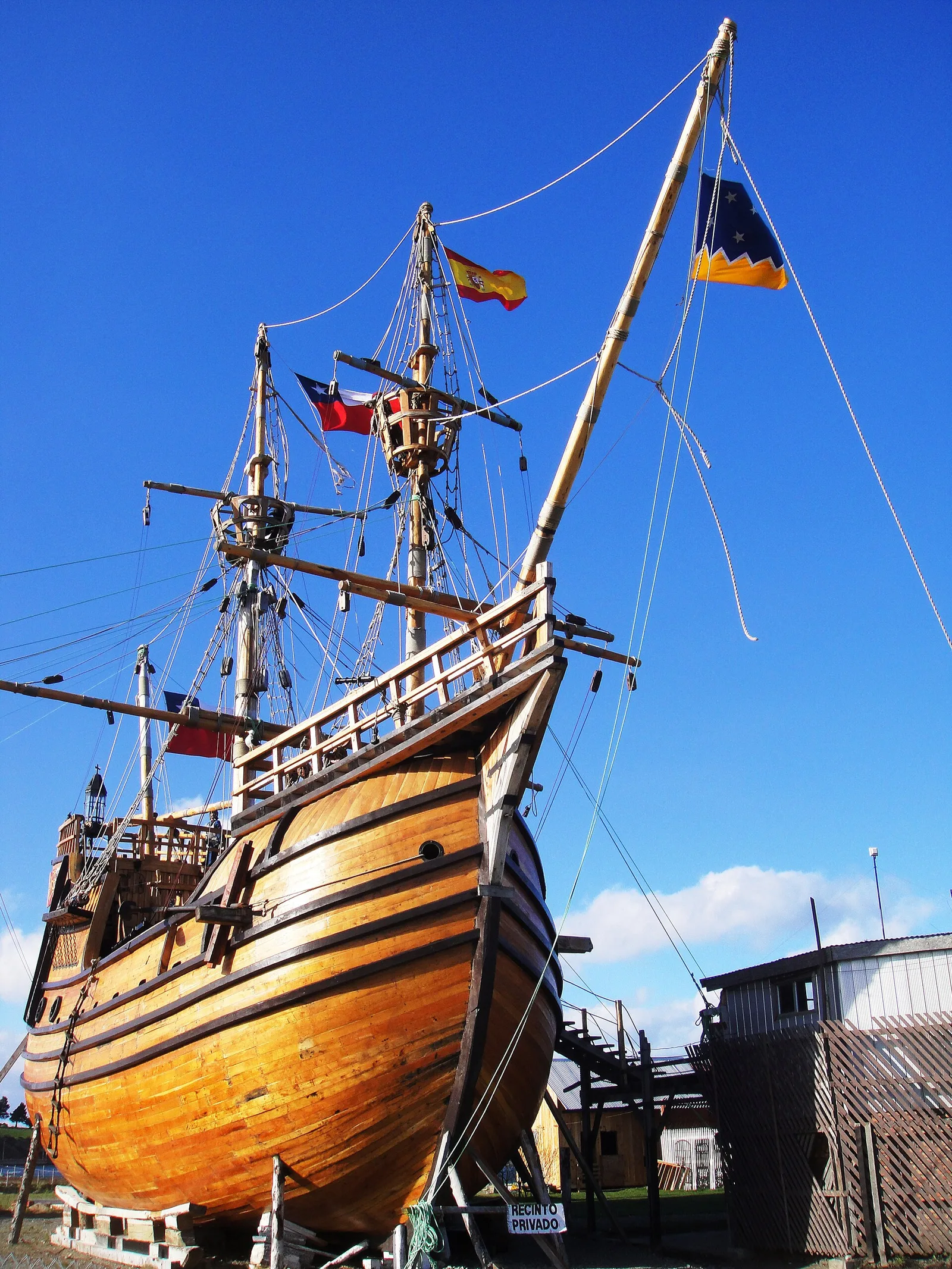
Replica of Hernando de Magallanes’s Nao Victoria in the city of Punta Arenas. Photo: Magallanes1, CC0, via Wikimedia Commons.
From Pigafetta’s notebook to today’s Patagonian coast
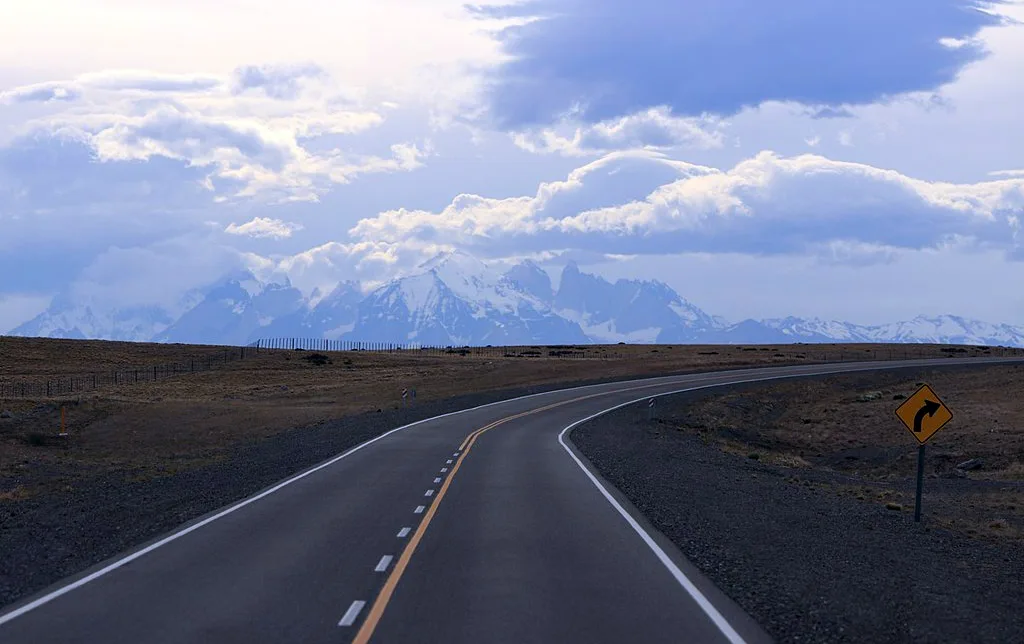
We jump five hundred years and return to today. Today the Strait of Magellan fulfills that blunt geographic function: it links the Atlantic and the Pacific and marks the boundary between the continent and the Isla Grande of Tierra del Fuego. The eastern sector, on the Atlantic side, is in Chilean territory, facing that Patagonia we tend to imagine full of wind and low horizons.
Now it’s accessible by land and by sea: roads and ferries from cities like Punta Arenas lead to viewpoints, ports, and spots from which to observe the interoceanic passage. Where they groped blindly for very safe harbors, today there are roads, signs, schedules, people who know how long a typical crossing takes. From the current Patagonian coast, you look out over a corridor of protected areas where marine wildlife, birds, southern forests, and regional museums coexist.
Institutions like the Museo de Magallanes prepared exhibitions and documents in 2020 to commemorate the 500 years of the crossing. Panels with maps, ship models, enlarged quotes from Pigafetta. The strait, which for the sailors of 1520 was an enormous risk, became part of the global historical memory of the first circumnavigations and, at the same time, a geographical milestone that travelers from all over the world look at today.
But there is something that hasn’t changed that much. Modern descriptions speak of a cold climate, strong winds, and rapid weather changes, exactly what the chroniclers of the 16th century were already mentioning, only now translated into alerts on your phone. If you go down to the coast on a nasty day, with gusts that make you bow your head and clouds moving fast, you can feel a tiny part of what those sailors must have felt as they looked at the same channel without knowing where it led.
If you ever go there —and I hope you do—, there’s no need for solemnity. You can be there with a mate in your hand, wearing a wool hat and a puffy jacket, and still let history seep a little into your skin. Think that where today you see a cargo ship crossing calmly, on a Wednesday in 1520 several carracks were sailing out to the “great sea” without ever having heard the word Pacific. For our hyperconnected lives, it does us good, every once in a while, to stand before a place that reminds us what it is to move with little information and a lot of courage.
What a windy Wednesday teaches us
All this happened on a Wednesday in November, at a remote point on the map, among people who were hungry, afraid, and full of doubts. There were no fireworks or marching band, there was wind, a smoothed-out sea, and a captain who decided to go on. Sometimes history is played out like this: in decisions that seem just a little braver than average.
Maybe that’s why this anniversary hits so hard. Because it brings the word “explorer” down to earth and brings it closer to our everyday lives. None of us is going to name an ocean, but we all have our own straits: uncomfortable decisions, paths that are not clear, reasonable fears, even though what we really need is just to find a way to begin.
In that sense, when we gaze out over the Strait of Magellan, we are not just looking at an incredible landscape. We are looking at a reminder that many things we take for granted today were once a big question mark. And that someone, at some point, had to say, “we’re going anyway.”
By Diego Pastuch Cover photo: Leonora (Ellie) Enking from East Preston, United Kingdom, CC BY-SA 2.0, via Wikimedia Commons.
Share
Rate this story
No ratings yet
0 comments
No comments yet. Be the first!
You may also like
 Saint-Exupéry among Patagonian winds and Mapuche names
 Darwin, Fitz Roy and the Yámanas: a misunderstanding at the end of the world
 Punta Arenas, the city that was written by the wind
 Jules Verne and the real lighthouse at the end of the world
 Getaway to Bariloche: 3-Day Itinerary and My First Time in the Snow at 50
 Fulfilling the Dream of Traveling to Ushuaia
 Journey of the Sailboat Galileo in Patagonia and Argentine Antarctica - 2nd part -
 Journey of the Sailboat Galileo in Patagonia and Antarctica by Commander Navas