Jules Verne and the real lighthouse at the end of the world
How did a lost lighthouse on Isla de los Estados end up igniting a novel by Julio Verne?
Can you imagine writing about a place you never visited… and still changing it forever?
In the late 19th century, in a remote corner to the east of Tierra del Fuego, night must have fallen like a stone. Horizontal rain, with wind that never stops roaring, sharp mountains silhouetted on Isla de los Estados that look like they were designed by someone in a very bad mood. And in the middle of all that, perched on a crag 60 meters above the sea, a lighthouse lit in 1884 to tell ships: “this way, very carefully.”
Thousands of kilometers further north, at a desk in France, someone lit another kind of light. Jules Verne, who never set foot in that San Juan de Salvamento lighthouse, gave it an immortal name: Le Phare du bout du monde. Since then, for half the planet, the “lighthouse at the end of the world” stopped being just a stubborn lantern in the Patagonian fog to become the setting for pirates, shipwrecks, and adventures.
Today I want to invite you on that strange trip: from the crag lashed by the South Atlantic to the silence of a studio in Amiens. And from there, back again, to Isla de los Estados. Because this story shows that, many times, imagination ends up in dialogue with geography.
An island sharp as a nagging memory
If you look at the map, Isla de los Estados seems like a splinter broken off from Tierra del Fuego and stuck into the Atlantic. It’s to the east of the Isla Grande, separated by the Strait of le Maire, and it measures about 65 kilometers long by 15 wide. Small in size, intense in character. Jagged coasts, fjords that cut in like knife slashes, abrupt mountainous relief. It’s one of those places that, if we compared them to people, would be the type that doesn’t shake your hand right away: it stares at you first, to see if you’re serious.
The climate doesn’t help much to make friends either. Cold oceanic, winds that never stop, frequent rains, thick fogs. For anyone who’s had a bad day stuck in city traffic, imagine that but with waves, rocks, and a captain trying to see something through the drenched glass of the bridge. For decades, that combination was synonymous with danger for sailors coming from the Atlantic toward the southern tip of the Americas.
That’s why in 1884 they lit a giant candle on the rock: the San Juan de Salvamento lighthouse, on Cape San Juan, at the northeastern tip of the island. It was the first Argentine lighthouse in the southern waters and, in its time, it came to be considered the southernmost on the planet. It wasn’t born with the nickname “lighthouse at the end of the world,” but it deserved it: being alone there, hanging over a crag, lighting up one of the most complicated seas, is a pretty literal way of living on the edge.
I like to imagine the first night it was lit. Some lighthouse keeper, bundled up in impossible layers, going out to inspect the structure while the wind makes that low ghost-train sound. Below, the South Atlantic crashing against the rocks. And far off, the silhouette of a ship that, thanks to that point of light, corrects its bow a few degrees and avoids becoming tragic news. No fanfare, a silent but effective service.
From a southern lighthouse to a desk in Amiens
Here we get one of those magical crossings history sometimes offers. From Isla de los Estados to Jules Verne’s work table in France there are thousands of kilometers, but the distance shrank thanks to stories. Sailors, officers, travelers; the echoes of that newly inaugurated lighthouse, of shipwrecks nearby, of the difficulties of navigating those waters at the far south began to reach Europe.
Verne didn’t need to set foot in a place to make it his own. He was the author of the Extraordinary Voyages, the guy who had sent his characters Twenty Thousand Leagues Under the Sea or From the Earth to the Moon without moving from his desk. And yet, with the San Juan de Salvamento lighthouse something special seems to have happened. The press and popular science texts agree that he was fascinated by that explosive mix: intense solitude, extreme geography, and a pinpoint of light lost in the storm.
Between March 29 and May 17, 1901, he wrote the manuscript of Le Phare du bout du monde. He worked fast, as if the waves were pounding on his window. The novel presents a plot in which a group of pirates turns off the lighthouse to cause shipwrecks and loot ships. That motif—the betrayed lighthouse, turned into a trap—is linked in popular bibliography to old tales of shipwrecks around Isla de los Estados. There’s no evidence that there were pirates like the ones in the novel right there, but there is that this sea already had a bad reputation long before Verne turned it into literature.
The sad part is that Verne never got to see his book in readers’ hands. He died on March 24, 1905, in Amiens. Le Phare du bout du monde later appeared as a posthumous novel. That’s where the dates get a bit misty—like the island that inspired it: various French sources and publishing catalogs agree in placing the publication in 1905, with a volume edition from the Hetzel house that year, while the bibliography of the Jules Verne Museum in Nantes dates it to 1906. And, at the same time, we know precisely that it was published in serial form in the magazine Magasin d’éducation et de récréation between August 15 and December 15, 1905.
We also know something else important: the text that was read was not exactly the one Verne left. His son Michel Verne revised and modified the manuscript before publication, to the point that in some catalogs the novel appears signed by both. Even so, behind those editorial hands, the same initial image beats: a solitary lighthouse, an end of the world, a writer looking at it from afar and wondering what would happen if one day that light went out.
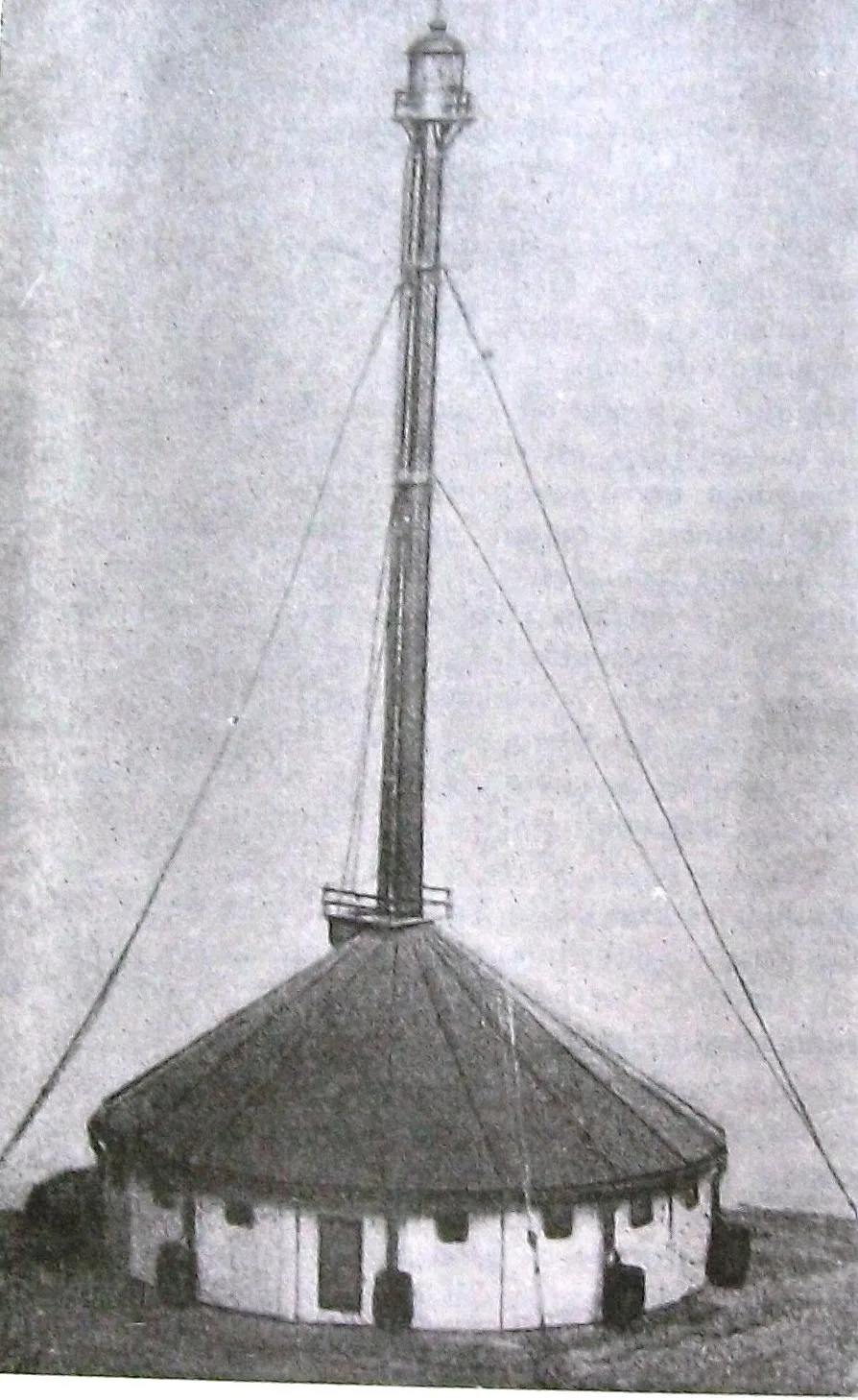
San Juan de Salvamento Lighthouse on Isla de los Estados, 1884–1902. Photo: Desconocido Unknown author, Public domain, via Wikimedia Commons.
The lighthouse that became more famous on the page than in stone
“Jules Verne wrote The Lighthouse at the End of the World about a place he never visited,” recalls a popular science article about the area. And yet, his novel did more for the fame of the San Juan de Salvamento Lighthouse than any tourism campaign. Argentine media such as La Nación and Página/12 agree that the book, published in 1905, made the lighthouse very popular and cemented its myth, associated with shipwrecks and pirates.
It’s striking: for almost a century, the real lighthouse was losing the contest against the paper lighthouse. The building constructed on the crag 60 meters above the sea—low, compact, built to stand up to the wind—was abandoned and fell into ruins. Meanwhile, the imaginary lighthouse stayed impeccable on the shelves of the world’s libraries, with George Roux’s illustrations in the Hetzel edition accompanying readers’ fantasies.
Isla de los Estados, for its part, never stopped being what it was: a small, mountainous island, battered by the weather, today part of the province of Tierra del Fuego, Antártida e Islas del Atlántico Sur. Its surroundings form the Isla de los Estados and Año Nuevo Archipelago Provincial Reserve, with restricted access to protect a very fragile environment. There are no mass excursions, no hotels, no easy selfies. Visitors who reach the region usually depart from Ushuaia, but regular boat trips are limited to the Beagle Channel; the San Juan de Salvamento Lighthouse lies more than 200 kilometers to the east, in an area where landing requires strict permits.
While the original lighthouse was rusting away in silence, its nickname was traveling without restraint. “Lighthouse at the End of the World” stuck to the global imagination. So much so that, years later, it would generate a funny (and rather persistent) mix‑up on the other side of Tierra del Fuego.
Two lighthouses and one nickname: the Beagle confusion
If you ever travel to Ushuaia, it’s very likely that someone will offer you a boat trip through the Beagle Channel. On those launches and catamarans, the must‑have photo appears: a lighthouse painted white and red, planted on a small islet, with snow‑capped mountains in the background. And almost always, some brochure presents it as “the lighthouse at the end of the world.”
The thing is, that lighthouse is called Les Éclaireurs, and it’s a different story. It’s in the Beagle, very close to Ushuaia, and it entered into service on December 23, 1920, years after Verne’s novel. It has no relation to Le Phare du bout du monde or to Isla de los Estados. It’s as if a stand‑in actor had ended up with the photo from the play.
Various websites and guides in the area make a point of clarifying it: the lighthouse that inspired Verne is San Juan de Salvamento, on Isla de los Estados; the one in the Beagle is beautiful, yes, but it’s playing in a different league. Even so, the confusion persists. Maybe because it’s easier to offer a “lighthouse at the end of the world” you can reach in an hour by boat than to explain that the real one is lost far out at sea, in a provincial reserve that almost no one can access.
For me, that confusion stirs up mixed feelings. On one hand, I get the tourism hook; on the other, it makes me want to sit you down and tell you, calmly, that far off there’s a half‑collapsed lighthouse whose light no longer guides ships, but still guides stories. And that this story was born in the head of a French writer obsessed with the edges of the map.
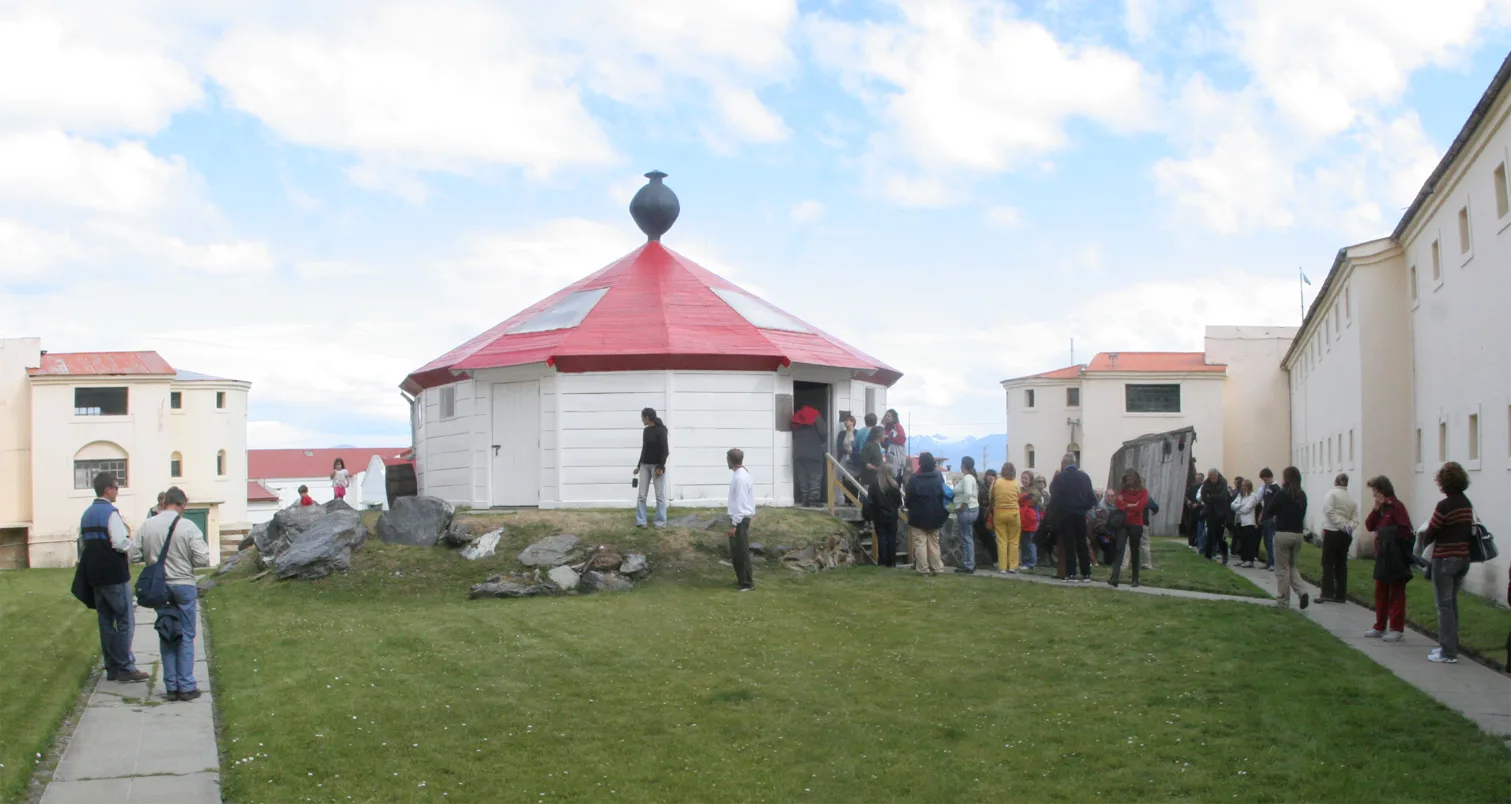
If you visit Ushuaia today, there’s an interesting bridge between the two realities: in the Maritime Museum, housed in the former prison, they built a full‑scale replica of the San Juan de Salvamento Lighthouse. There, indoors and out of the wind, you can circle the building with your eyes, the one that on Isla de los Estados is now a ruin. It’s like stepping into a scale model of a novel.
The first time I walked through those rooms, I stopped for quite a while in front of the panels that recount the shipwrecks. I was struck by the stories of countless ships sunk in those waters, which are especially difficult for navigation, one after another, like an echo of what Verne imagined in his novel. And, at the same time, I was impressed to think that all that violence of the sea unfolds in front of an island that today is uninhabited, alone out there, standing up to the wind.
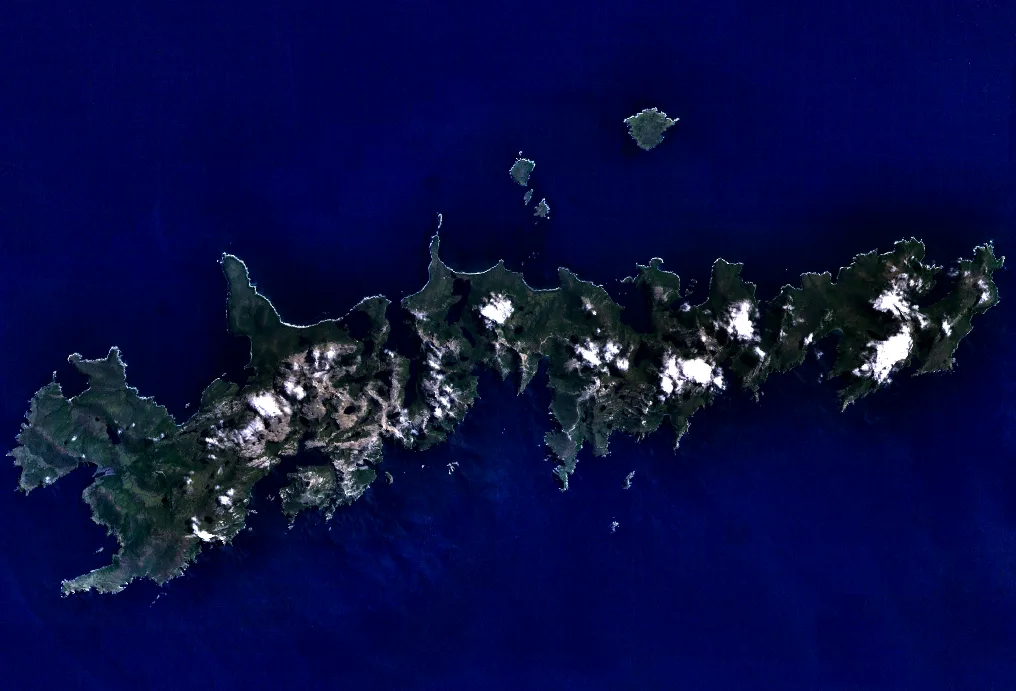
View of Isla de los Estados from the northwest. Photo: Unknown author, Public domain, via Wikimedia Commons.
When a reader crosses the ocean for a book
The loveliest proof that Verne’s imagination kept lighting beacons came, a century later, from another Frenchman: André Bronner. A reader fascinated by The Lighthouse at the End of the World, in 1994 he decided to do what Verne never did: go in search of the real lighthouse. He sailed to Isla de los Estados, reached Cape San Juan, and found what was left of the building: remnants, ruins, the shadow of the original structure erected in 1884.
Instead of being satisfied with the anecdote, he went back the following year and stayed three months isolated on the island. Three months. Think about it from an everyday perspective: how long can you last without cell signal, without city noise, without the possibility of going out to buy bread? Bronner chose to put his body where, until then, only Verne’s words had been.
His stay is part of a longer process of recovering the lighthouse’s memory. Back in 1989, a first survey of the area had already been carried out with staff from the Museo Territorial de Tierra del Fuego. After that came projects and work to better understand what that first Argentine southernmost lighthouse had been like and how it had operated.
I like this sort of triangle that takes shape: Isla de los Estados – Jules Verne – André Bronner. The extreme geography that generates stories; the stories that travel and fire up a writer; the writer who leaves a posthumous novel; the book that, decades later, programs the emotional GPS of a real sailor. And so, as a ricochet, the world’s gaze returns to a 65 by 15 kilometer island, battered by rain and wind.
I am still surprised by the power of that chain. A lighthouse built to prevent shipwrecks ends up preventing, perhaps, another kind of shipwreck: that of oblivion.
A light lit between maps and dreams
If the story of the San Juan de Salvamento lighthouse and of The Lighthouse at the End of the World teaches anything, it’s that places are not exhausted by their coordinates. Isla de los Estados is longitude, harsh climate, mountainous terrain, a provincial reserve with restricted access. But it is also what a writer imagined in 1901, what a French illustrator drew in 1905, what a sailor sought a century later, what you and I think now as we read these lines.
Sometimes we believe adventures are reserved for others: for those who cross seas, for those who have lighthouses, for those who are the first to reach the edges of the map. But Verne wrote about a place he never visited and still left a concrete mark on that rock in the South Atlantic. Bronner crossed the ocean driven by a book. And that book was born, in part, because a group of lighthouse keepers lit a huge lantern for the first time in 1884, under wind and rain.
Maybe that’s the lesson: what we do in a small corner can travel far, and I’m not just talking about distance. A story you tell, a photo you take, an idea you jot down in a notebook on a windy night can end up in someone’s maps thousands of kilometers away. We don’t know who will read our “lighthouse” or when, but it’s still worth lighting it.
Next time you hear talk of the end of the world, remember that sharp island, that lighthouse on the rocky outcrop, and a French writer imagining storms he never lived through. And ask yourself, in a low voice: what lighthouse is it my turn to light?
By Diego Pastuch Cover photo: JIB60, CC BY-SA 3.0, via Wikimedia Commons.
Share
Rate this story
No ratings yet
0 comments
No comments yet. Be the first!
You may also like
 Getaway to Bariloche: 3-Day Itinerary and My First Time in the Snow at 50
 Fulfilling the Dream of Traveling to Ushuaia
 Journey of the Sailboat Galileo in Patagonia and Argentine Antarctica - 2nd part -
 Journey of the Sailboat Galileo in Patagonia and Antarctica by Commander Navas
 Ushuaia, the City at the End of the World… where everything begins
 An Unsettling Experience in Victoria Island
 Jurassic Park in Southern Patagonia
 156 Years Ago, the Ship Mimosa Set Sail for Patagonia