156 Years Ago, the Ship Mimosa Set Sail for Patagonia
On July 28, we commemorate the 156th anniversary of the arrival of the Welsh settlers on the coast of what is now Puerto Madryn. During this time, it is common for a significant number of new historical works about the Welsh, the colony, and the...
Machine translation.
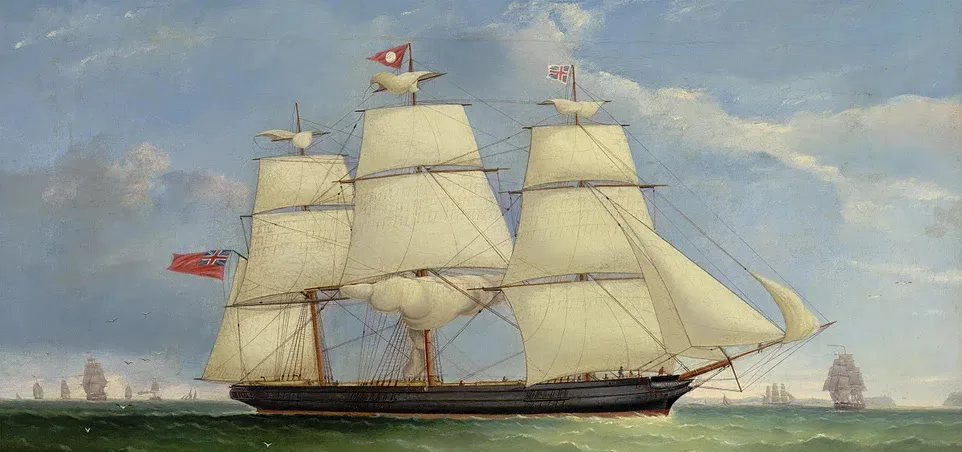
156 years ago the sailing ship Mimosa was the vessel that brought the 153 Welsh settlers in 1865, who began to be part of Patagonia living in precarious constructions in what is today known as Punta Cuevas.
On July 28, we commemorate the 156 years since the arrival of the contingent of Welsh settlers to the coast of what is now Puerto Madryn. During this time, it is common for a considerable number of new historical works about the Welsh, about the colony, and about what were the seeds of the first stable populations in Patagonia to emerge (let's remember that all previous attempts at colonization failed in various ways). I will contribute my grain of sand for the occasion, sharing some thoughts.
First of all... why "Mimosa"?
The name is striking, with Latin and affectionate reminiscences, for an English cargo ship. It is a name one would expect to find on a Spanish boat in the Mediterranean, or some leisurely Central American pleasure yacht anchored lazily in Yucatán. But it is hard to associate "Mimosa" with an Anglo-Saxon sailing ship or clipper loaded with tea and sailing the coasts of Africa or America. However, upon digging a little into the use of this name in English, we can find that, just like in Spanish, "Mimosa" can refer to other meanings, such as some species of trees, like the acacia, shrubs, or it is also one of the names of one of the stars that make up the Southern Cross: Beta Crux, Becrux, or Mimosa. Perhaps the person who named it was thinking of a forest of acacias, or wild shrubs with the same name. I like to think that its name was given with a view to the sky, to that small constellation that helps navigators and travelers find the south. Let's say it would be a prophetic name, a sign of the path to be followed by that sailing ship, which would forever be associated with Patagonia.
The Southern Cross. To the left, Becrux or Mimosa can be distinguished, a subgiant star that is seven times larger than our sun and is located 280 light-years away. It is a very young star, which is presumably accompanied by one or more forming dwarf stars. Source: constellations.
Memories of the summer of 1853
Old records say that the sailing ship/clipper Mimosa was built by Hall & Co of Aberdeen (Scotland) and launched in the summer of 1853. According to a brief text extracted from the Aberdeen Journal on Wednesday, June 22, 1853, the launch took place on June 21 and the ship's destination was primarily trade with South America, as can be inferred from the text of the note:
Aberdeen Journal Wednesday 22 June 1853:
'Yesterday there was launched from the building yard of Messrs Hall, a splendid ship-rigged vessel, named the 'Mimosa'. Her measurement is 447 tons, new measurement and 540 tons old measurement. The 'Mimosa' is the property of Liverpool owners and is the third vessel which Messrs Hall have built for the same parties. She is intended for the South American trade and is to be commanded by Mr Kemp, a gentleman of long experience, whose fair partner gave the vessel her name. The 'Mimosa' is a really splendid ship and promises to be worthy of her builders. She at present lies at Provost Blaikies Quay.'
The logbook of the Mimosa
I do not know if the logbook of the sailing ship/clipper Mimosa has been preserved, partially or totally. The chronicles of the journey that we have, at least those that are commonly cited, correspond to the accounts of some of the Welsh settlers who traveled on board. In the digital archives of the British Library, there is a series of image collections that fall within the Endangered Archives Programme, among which there are some that include numerous photos of Patagonian places or themes. In particular, one of these collections, titled simply as Patagonia [1910s-1930s], contains a photo of what is supposedly the cover of the logbook of the historic sailing ship/clipper. The photo, identified as "Foto Stillitani," is dated June 1937 and claims to be a reproduction of the first page of the Mimosa. At the top, it reads in Welsh "Covnodion Mordaith y Mimosa," something like "Logbook of the Mimosa," followed by a sketch of the sailing ship, which is defined as "Brik-bark" (Bricbarca, a type of three-masted sailing ship). Below the drawing are the notes for the days 24, 25, 26, 27, and 28 of May 1865. Unfortunately, the handwritten notes are almost illegible, except for that of Friday, July 26, which seems to be a newspaper clipping (perhaps the captain forgot to make the entries, or simply, that day he didn't feel like writing).
First page of the logbook of the sailing ship Mimosa, as it appears in the archives of the British Library.
Four passages to the unknown
Another curious thing that comes to mind is a scanned image of what was the invoice or ticket of purchase for the Welsh reverend Abraham Matthews and his family: his wife, Gwenllian, his daughter, Mary Annie (newborn), his brother-in-law, John Murray Thomas, and Mary Ann John (I am not sure about this last one). The invoice states that the sailing ship Mimosa was to depart from Liverpool bound for "New Bay" (Bahía Nueva). In the fine print of the contract, it can be seen that each adult passenger "will have no less than 10 cubic feet (283 liters) of luggage space." To have an idea in terms of modern vehicles, it is almost the cargo capacity of a Chevrolet Tracker today.
Ticket of Abraham Matthews and family to board the Mimosa. Source: Glaniad.
For the most curious, I can tell you that on several websites we can review the complete passenger registry of the Mimosa, with their origins and relationships. Some of them are:
Familysearch
Clwyd Family History Society
Welsh Settlers in Patagonia
Old Records
The sailing ship Mimosa was not operational for too many years, just over twenty, but it was enough time for it to travel half the world transporting cargo. It is possible to find several online records where the Mimosa appears in the lists of registered merchant ships from the United Kingdom.
Old records of British merchant ships where the sailing ship Mimosa, of 410 tons, is listed with the registration number 1973 and the letters HMFN. Sources: Google Books and Archive.org
In "The universal code of signals for the mercantile marine of all nations," by Frederick Marryat and G B. Richardson, in addition to the sailing ship Mimosa being registered, signal codes for the identification of ships can also be found. If I understand correctly, in the case of the Mimosa, it would correspond to the sequence of flags 1-9-7-3. Source: Archive.org
And where is the Mimosa?
The fate of the sailing ship Mimosa, according to Google and Wikipedia (the closest thing to an oracle), is that it sank in the delta of the New Calabar River, in southern Nigeria, at the end of 1872. There are no details on how it happened, which raises the question of whether the wreck is well preserved, if it is accessible, if its trace has been lost, and a long etcetera of similar questions. There is a highly cited book (but out of my reach) that recounts the details of this ship's history, titled "Mimosa, The life & time of the ship that sailed to Patagonia," by Susan Wilkinson. There, it apparently states that the sailing ship was used as a depot pontoon for palm oil in New Calabar, and that it was scrapped in 1880. Also, the Crew List Index Project (CLIP) database keeps a record of British ships from 1880 where the Mimosa appears as a registered ship, owned by Stuart & Douglas. It would be interesting to investigate this matter further and check if there is any historical record in Nigeria that clarifies things. I will try to look into this a bit more in the future (read "when I can," where "when I can" means a couple of years).
Map of Nigeria identifying the delta formed, among others, by the New Calabar River, near Port Harcourt (not to be confused with Calabar, which is further east, bordering Cameroon). Source: The best time to visit.
The (sailing ship) Mimosa Today
To conclude, I want to tell you that today there are two 1:50 scale replicas of the sailing ship Mimosa. One is located in Liverpool, the ship's departure point, and the other is in the Landing Museum, in Puerto Madryn, just meters away from where the first (and tough) months of the Welsh settlers were spent before embarking on their final journey to the Chubut River valley. This replica was built by the naval model maker Héctor Francisco Martinoia for the celebrations of the sesquicentennial of the arrival of the Welsh settlers in 2015. It is a highly detailed handcrafted work that gives a complete idea of the conditions in which that contingent of men, women, and children traveled in search of a dream and a new land.
Model of the Mimosa located in the Landing Museum, in Puerto Madryn. According to a comment from the model maker himself, Héctor Francisco Martinoia, to give us an idea of the size of the Mimosa, we can compare it with the corvette ARA Uruguay, which is anchored in Puerto Madero (Buenos Aires). The sizes are almost the same (in fact, the Mimosa was 3 meters shorter), which surprises me even more because I find it hard to understand how they accommodated 153 passengers plus 18 crew members in such a small space for two months.
The sailing ship Mimosa has been immortalized, among other things, in the municipal coats of arms of the cities of Puerto Madryn (left) and Trelew (right). Source: Blog "Herádica en la Argentina".
A little over a century and a half ago, a peaceful colonization process began that linked two worlds as different as Wales and Patagonia. Although the starting point is a few years earlier, in the minds of those who promoted the idea of a "New Wales," it practically became a reality when the sailing ship/clipper Mimosa cast off from the British Isles and headed south towards a nearly mythical territory. Its imprint lasts to this day and will surely endure for a long time to come. In the meantime, we will continue to explore the paths surrounding Bahía Sin Fondo, in search of new stories. Until next time.
By Patricio Donato
Researcher at CONICET (Smart Electric Networks)
History enthusiast of Patagonia
Editor of the blog Bahía Sin Fondo
Share
Rate this story
No ratings yet
0 comments
No comments yet. Be the first!
You may also like
 Getaway to Bariloche: 3-Day Itinerary and My First Time in the Snow at 50
 Fulfilling the Dream of Traveling to Ushuaia
 Journey of the Sailboat Galileo in Patagonia and Argentine Antarctica - 2nd part -
 Journey of the Sailboat Galileo in Patagonia and Antarctica by Commander Navas
 Ushuaia, the City at the End of the World… where everything begins
 An Unsettling Experience in Victoria Island
 Jurassic Park in Southern Patagonia
 The Search for an Elusive Passage and the Disappearance of an Imaginary River