
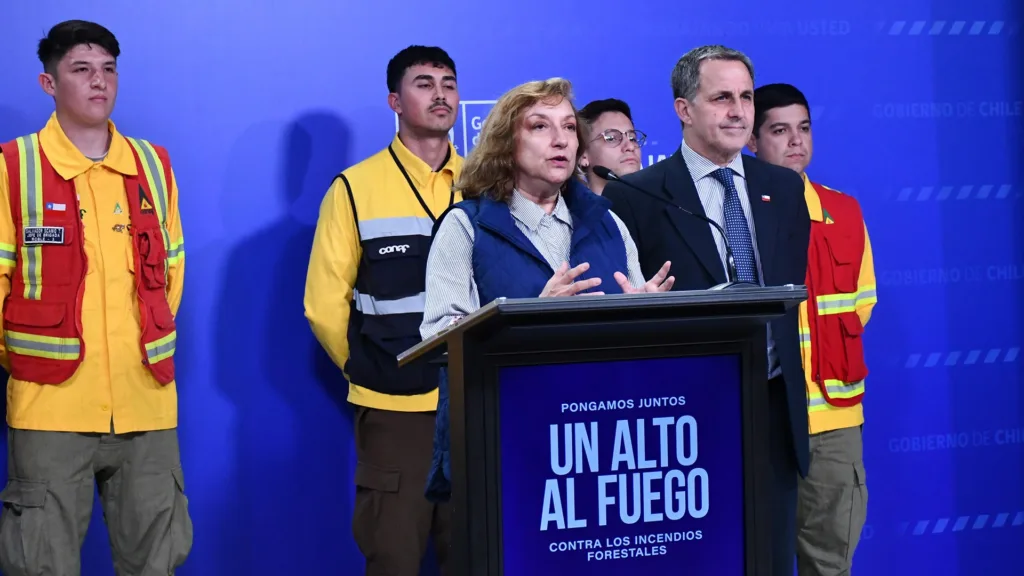
Chile launches 2026-2027 “Juntos pongamos un Alto al Fuego” campaign against forest fires
The “Juntos pongamos un Alto al Fuego” campaign seeks to prevent forest fires in Chile for the 2026-2027 season, focusing on people’s behavior.
On Monday, November 16, 2026, the Government of Chile, through the Ministry of Agriculture and the National Forest Corporation (CONAF), presented the 2026-2027 national campaign for the prevention of forest fires: “Together Let’s Put a Stop to Fire” (“Juntos pongamos un Alto al Fuego”). The initiative starts in the middle of spring, before the rise in temperatures, and is aimed at those who spend the summer, live or work in rural areas, urban-rural interface zones, and areas with native forest or plantations.
The campaign will run throughout the 2026-2027 fire season. It reinforces a central message: forest fires can be avoided if we change everyday habits. For travelers, residents of La Araucanía and other southern regions, and communities neighboring parks and reserves, the appeal is direct: review how fire, electricity and tools are used outdoors before the most critical period begins.
What the campaign “Together Let’s Put a Stop to Fire” contains
“Together Let’s Put a Stop to Fire” is the official forest fire prevention campaign for the 2026-2027 season in Chile. It is driven by the Ministry of Agriculture and CONAF and concentrates the Government’s communication efforts in the face of the risk of fires in rural and forest areas.
The campaign resumes CONAF’s historic slogan, “Preventing a forest fire is easier than fighting it,” as the guiding thread of all its pieces. The focus is placed on everyday responsibility: actions such as poorly extinguished campfires and precarious electrical installations —in general any work that produces sparks— are highlighted as critical points that each person can control.
The actions of “Alto al Fuego” will be deployed throughout the season of greatest risk, with dissemination in mass media and on-the-ground work by CONAF teams in regions prioritized for their history of fires, among them La Araucanía.
Two strands of the campaign: testimonies and animals
According to information provided by CONAF, the campaign has two major communication focuses.
The first is based on real testimonies from people who have lost property and their environment due to forest fires. These are stories that seek to challenge those who, through carelessness or negligence, start a fire that then gets out of control. Through these accounts, the concrete impact on homes, livelihoods and landscape is shown, associating it with a preventive gesture that could have been made in time.
The second focus uses native and domestic animals that appear interacting with dangerous human actions: a poorly extinguished campfire, a bad electrical installation, the use of tools that generate sparks. These scenes emphasize that the damage reaches both forests and plantations as well as wildlife and companion or working animals.
Both strands seek to reach those who live with fire as well as those who consider it distant until the flames reach them.
What it seeks to change: everyday habits and community work
CONAF states that the underlying objective is to achieve, in the medium and long term, a cultural shift toward preventive behaviors in the face of fire. The goal is not limited to the 2026-2027 season, but aims to establish permanent practices in rural neighborhoods, subdivided lots, interface zones, and towns near forests.
The institution highlights self-protection and community work, for example with the construction of firebreaks and the cleaning of roofs and yards. Among the simple actions it promotes are the construction of firebreaks, the cleaning of roofs and yards, the proper management of garbage “throwing garbage in containers,” and the elimination of risky behaviors such as throwing cigarette butts from vehicles or in areas with dry vegetation.
The message is aimed at both residents and visitors: those who spend the summer or go on excursions in rural areas are also part of the problem or the solution. A poorly extinguished campfire in a campsite, a spark from a tool on a property, or an informal burn can trigger fires that later require brigades, aircraft and evacuations.
La Araucanía: early coordination for the 2026-2027 season
In the Region of La Araucanía, with high recurrence of fires, preparation for the 2026-2027 season has been worked on since winter. On June 3, 2026, a “Regional Risk Management Board for the Threat of Forest Fires” was held, where SENAPRED, CONAF, regional authorities and various public services coordinated preventive and educational actions.
At that meeting, the importance of early planning and inter-institutional coordination was emphasized, with a focus on the experience of recent seasons and the large fires that occurred in previous years. This work serves as a basis for the new communication campaign to have operational backing: brigades, protocols and local networks that are better prepared.
For those who travel through La Araucanía —from rural sectors to access points to the mountains and passes toward Argentine Patagonia— this combination of preventive messages, institutional coordination and community work defines the scenario in which the 2026-2027 season will be experienced.
What it means for those who travel or live near natural areas
Although the campaign is designed for all of Chile, its message is especially key for those who live in or visit the southern macro-zone, including Chilean Patagonia and neighboring regions. Areas of forest, scrubland and forest plantations close to homes, roads and tourist attractions are especially sensitive to careless use of fire.
In areas close to parks, reserves and Andean lakes, the measures suggested by CONAF —cleaning roofs, clearing vegetation around homes and sheds, maintaining firebreaks, taking care with waste disposal— become part of the routine before summer. For visitors, checking whether there are restrictions on making fires, following park ranger instructions and avoiding every unnecessary spark are the minimum actions to ensure that the 2026-2027 season unfolds without major emergencies.
If you are planning a trip or have a plot of land in risk zones, organize cleanup days with neighbors now, check electrical installations and look for recreation alternatives without open fire. Small changes in everyday behavior are the core of what “Juntos pongamos un Alto al Fuego” seeks to establish for this and future seasons.
More information: CONAF – Preparedness in La Araucanía · Forest fire indicators – Minagri/CONAF
Source: CONAF Chile
Frequently asked questions
- When was the “Juntos pongamos un Alto al Fuego” campaign for the 2026-2027 season launched?
- The campaign was presented on Monday, 16 November 2026 by the Ministerio de Agricultura and CONAF.
- Which institutions are promoting the 2026-2027 campaign against forest fires?
- The campaign is promoted by the Ministerio de Agricultura of the Gobierno de Chile and the Corporación Nacional Forestal (CONAF).
- What is the main objective of the “Juntos pongamos un Alto al Fuego” campaign?
- It seeks to generate a cultural shift toward preventive behavior regarding fire, promoting self-protection and community work to avoid forest fires.
Original source: conaf.cl
Share
Rate this story
No ratings yet
0 comments
No comments yet. Be the first!
You may also like
 Hike to Lago Guillelmo on November 1
 Lessons from Albardão for the conservation of the Mar Patagónico
 Living Mountains 2026: Knowing to Care
 Interpretive tour of major Malvinas milestones in Puerto Madryn
 First edition of the cultural festival “Madryn se encuentra”
 Fourth edition of Lobo Beach in Puerto Madryn
 Camino de la Fe: a journey through the stories that connect Neuquén
 Excursion to Cerro Negro and Laguna Negra with GEDA